
David Village Lighting is one of the UK's best-known independent designer lighting retailers. David and Liz Village founded the business in Sheffield in 1981, and it now trades from The Old Cinema in Broomhill, stocking more than 100 designer brands including Flos, Louis Poulsen, Artemide, Tom Dixon and Foscarini. As well as selling to the public, they offer a lighting design service, supply thousands of trade and commercial clients, and are the UK distributor for Artemide Architectural.
We have been their website provider and technical support since 2009. Over that time the shop has grown from a UK retail site into an international store that sells in seven currencies, and the system behind it has grown with it.
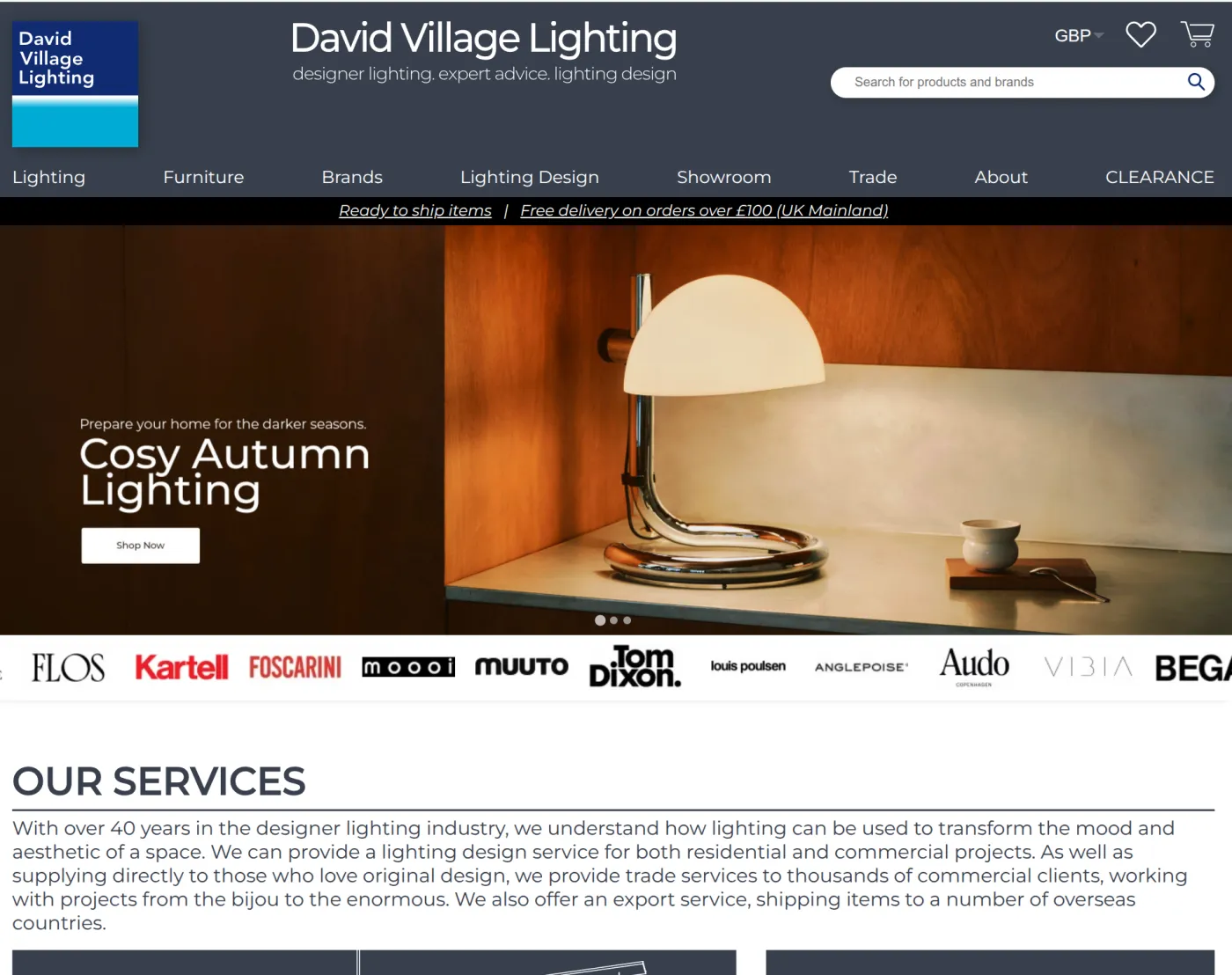
Our work with David Village Lighting started in February 2009, which makes them one of our longest-standing clients. The platform that runs the shop today has been developed continuously since 2013, one improvement at a time, as the business added international sales, trade customers, furniture and a much larger catalogue.
That continuity matters. When a pricing rule, a delivery exception or an accounting quirk needs changing, the people changing it know why it was built that way in the first place.
Artumi have been our website provider and technical support for well over 10 years, and have been a major part of our company’s growth in that time. They offer a very professional, smooth, and reliable service, and just as importantly, are easy to work with – and always available.
Designer lighting doesn't behave like most retail. Many pieces sell in small numbers, some are made to order, and a single design can come in dozens of finishes, sizes and fittings. Prices are set by European manufacturers in their own currencies, discounts are negotiated brand by brand, and delivery depends on what is being sent and where it is going.
Standard ecommerce platforms can be stretched to cover some of this with plugins, but not all of it, and not without the plugins fighting each other. The business needed rules that matched how it actually trades, so we built them.
The catalogue is large for the size of the business, because designer lighting is broad rather than deep: lots of different items, each held in small quantities or ordered in when a customer wants one.
Products are organised in three levels:
This is what lets a product page like the Tom Dixon Melt pendant offer eight finishes, each showing its own stock and price, while the catalogue stays manageable for the staff who maintain it. Products are also grouped by brand, application (pendants, wall lights, floor lamps) and curated collections, so the same item can be found from several directions.
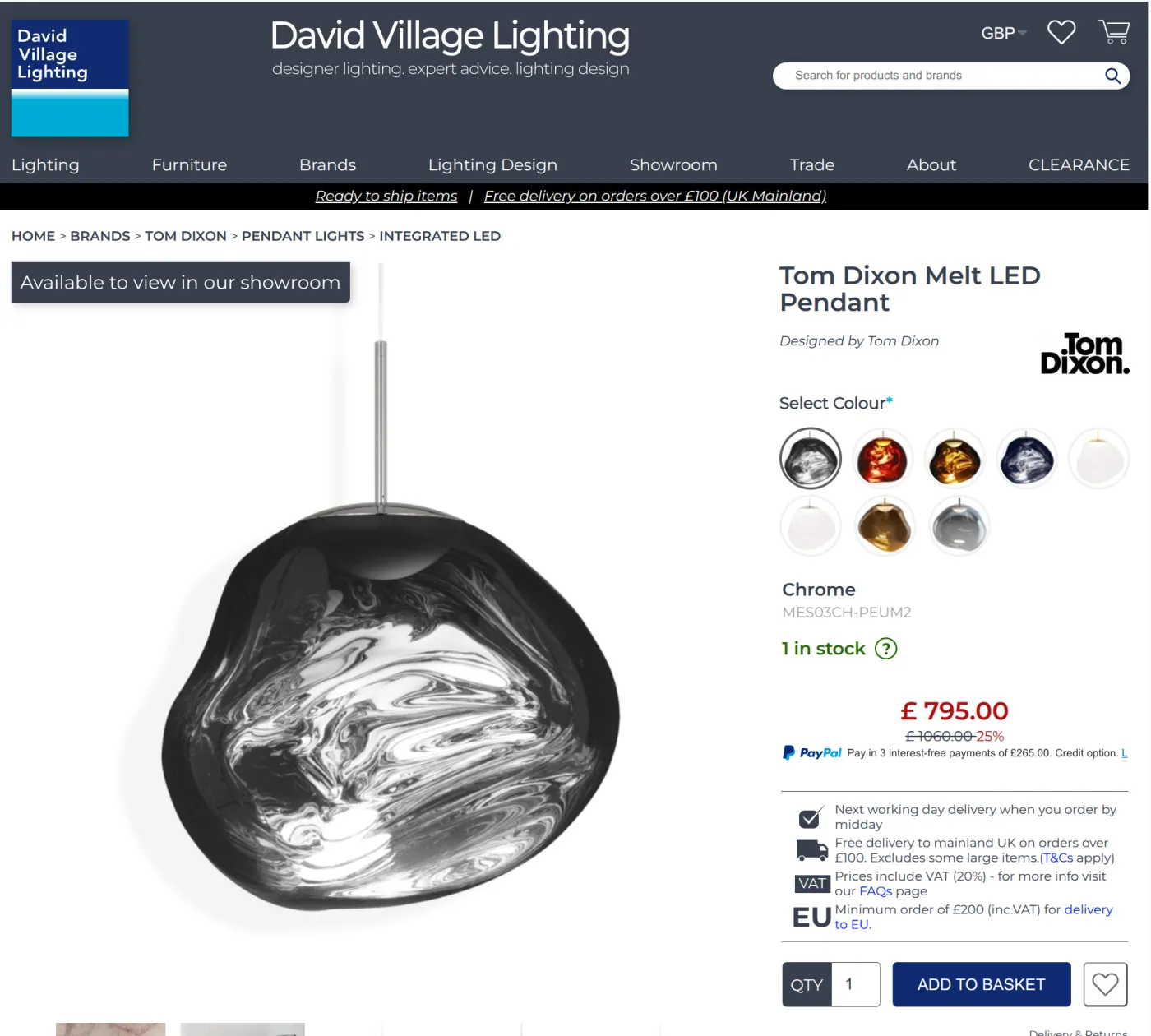
Customers can shop in pounds, euros, US dollars, Hong Kong dollars, Swedish and Danish kronor and Australian dollars, and visitors are offered their country's preferred currency automatically.
The complication is on the way in. Manufacturers' price lists arrive in their own currencies, so each brand records the currency its prices are stored in and the conversion to apply. Prices are imported from the suppliers' spreadsheets, converted, and then priced for each selling currency, with VAT handled according to where the order is being delivered. If a product doesn't have a price in a customer's currency, the system logs it for the team rather than guessing.
Because all of this is worked out in advance and cached, product and category pages still load quickly, even when they list hundreds of variants.
Discounts in this industry are usually agreed with a brand, not product by product. The shop lets the team set a discount for a whole brand in one place, and then override it for a particular product or a single variant when needed. The most specific discount wins: variant, then product, then brand.
The result is shown on every product page as the recommended price, the sale price and the percentage saved, in whichever currency the customer is using. Voucher codes can be limited to particular brands too, which keeps promotions in line with the agreements behind them.
Delivering a table lamp to Sheffield is simple. Delivering a large pendant to Hong Kong, or a piece of furniture to Northern Ireland, is not, and no fixed table of charges gets it right.
For UK mainland orders, delivery is calculated at checkout from the postcode and the contents of the basket, including local and national furniture delivery and Saturday delivery. For overseas orders, special orders and some furniture deliveries, the customer can still place the order, but the delivery cost is marked as unconfirmed. The team then gets an accurate quote from the courier and confirms the final cost with the customer, so neither side ends up paying for a guess.
With so many items held in small numbers or made to order, an order can't simply be treated as "in stock, ship it". Each variant carries its own stock count and lead-time notes, which are shown to the customer before they buy. Orders then move through clear statuses (ordered, paid, processed, out of stock, shipped, refunded), so the team can see at a glance what is waiting on a supplier and what is ready to go.
Paid orders are exported to Sage in the format its import expects, line by line, with the order number, item, code and amounts. Each order is exported once and marked as done, so nothing is entered twice and nothing is missed. The accounts team gets the sales data without retyping it from the website.
None of this comes in a box. It is custom logic, written around how David Village Lighting actually trades, and it is the kind of work we do best: ecommerce and bespoke systems that fit the business, rather than a business bent to fit the software.
If your online shop needs rules that an off-the-shelf platform can't handle, we can help you work out what to build and how.
Please provide your details below and we will do our best to get back to you.
Prefer to talk? Call us on 0114 299 8033, 9am–5pm Monday–Friday.
Artumi Systems Ltd. Company Number 8557359
VAT Reg 889031788
Phone number: 0114 299 8033
Opening hours: 9am–5pm, Monday–Friday